Call: 713-850-8466

Borers—especially pine bark beetles—are among the most destructive insects affecting trees in the Houston area. These pests invade tree trunks and branches, tunneling through the inner bark and sapwood. Their activity disrupts the tree’s vascular system, which is responsible for transporting water, nutrients, and sugars. Pines under drought stress, root damage, or poor site conditions are particularly vulnerable, making urban trees an ideal target for these insects.
Houston’s pine trees are an important part of our landscape, providing shade, beauty, wildlife habitat, and privacy for homeowners. Unfortunately, these valuable trees can become targets for one of the most destructive insect groups in the southern United States—pine bark beetles and wood-boring insects.
While these pests are small enough to fit on a grain of rice, their impact can be devastating. Every year, bark beetles contribute to the decline and death of thousands of pine trees across Texas. In many cases, homeowners don't notice a problem until significant damage has already occurred.
Understanding how these insects operate, why they attack, and what warning signs to look for can help protect your trees before irreversible damage occurs.
Pine bark beetles belong to the family Curculionidae (weevils) and the subfamily Scolytinae. Common species found throughout Southeast Texas include the Ips engraver beetle and the Southern Pine Beetle.
Unlike insects that feed on leaves, bark beetles attack a tree's vascular system. Adult beetles tunnel through the bark and lay eggs beneath the surface. As larvae hatch, they feed on the living tissues responsible for transporting water and nutrients throughout the tree.
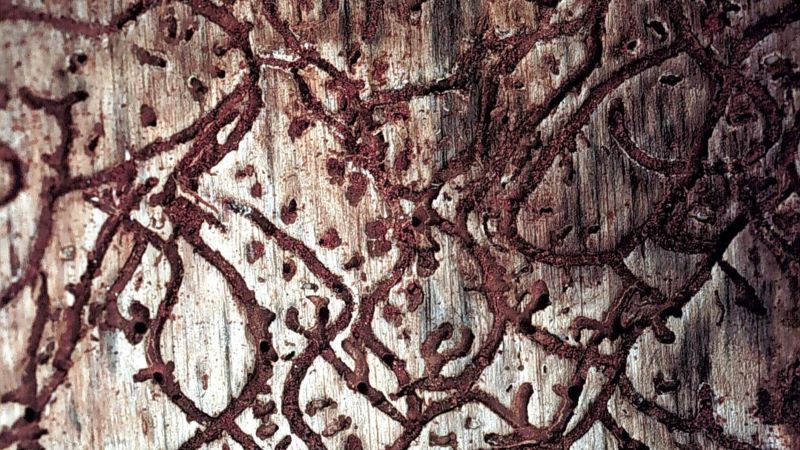
The resulting network of feeding tunnels, called galleries, can effectively girdle the tree, cutting off its ability to sustain itself.
Houston's long growing season and warm climate allow bark beetles to reproduce rapidly. During favorable conditions, multiple generations can occur within a single year, allowing infestations to spread quickly through stressed pine populations.
Most bark beetles naturally target weakened, damaged, or stressed trees. Unfortunately, urban trees often experience conditions that place them under constant stress.
Common factors that increase susceptibility include:
A healthy pine tree produces large amounts of resin (sap), which serves as its primary defense against invading insects. When a tree becomes stressed, resin production declines, making it much easier for beetles to successfully colonize the tree.
This is one reason Houston often experiences increased bark beetle activity following drought years, hurricane damage, or major construction projects.
Early detection is critical. The sooner an infestation is identified, the greater the chance of protecting nearby trees and minimizing losses.
Watch for these common warning signs:
Small blobs of resin that resemble popcorn or candle wax on the bark. These form when the tree attempts to push invading beetles back out of their entry holes.
Fine sawdust-like material collecting in bark crevices, around the trunk flare, or at the base of the tree.
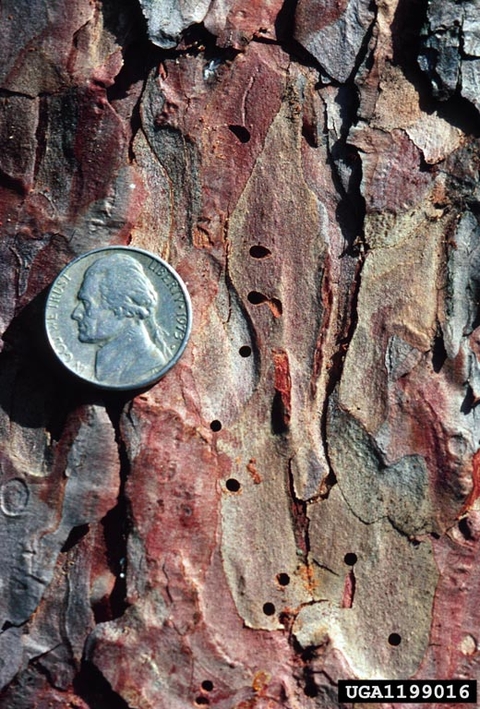
Tiny round holes or characteristic D-shaped exit holes may be visible in the bark.
The upper portions of the canopy may begin to thin as water movement becomes restricted.
Individual branches suddenly turn yellow, orange, or brown while the rest of the tree remains green.
As infestations progress, sections of bark may begin peeling away, revealing intricate beetle galleries underneath.
Needles may change from green to yellow, then reddish-brown over a relatively short period of time.
Unfortunately, once the entire crown begins turning brown, recovery is often unlikely.
Many bark beetles don't work alone.
Several species carry specialized fungi that are introduced into the tree during colonization. These fungi help weaken the tree's defenses while creating a favorable environment for developing larvae.
This relationship is known as symbiosis—both organisms benefit from working together.
In many cases, the fungal infection contributes significantly to tree decline, accelerating mortality even after beetle activity decreases.
Because bark beetles are often secondary attackers, maintaining tree health remains the most effective long-term management strategy.
Homeowners can reduce risk by:
Healthy trees are far better equipped to defend themselves against insect attacks.
In areas with a history of bark beetle activity, preventative trunk sprays may be recommended during high-risk periods.
These treatments work by creating a protective barrier that prevents beetles from successfully entering the tree. Timing is critical, as treatments are most effective before infestation occurs.
Once beetles are actively established beneath the bark, treatment options become significantly more limited.
A certified arborist can determine whether preventative applications are appropriate based on tree species, site conditions, and current beetle pressure.
Severely infested trees often cannot be saved.
In these situations, prompt removal may be necessary to reduce the likelihood of beetles spreading to neighboring pines.
Dead and declining trees can also become structural hazards, especially during Houston's hurricane season when high winds increase the risk of failure.
Removing infested trees early can protect both nearby trees and surrounding property.
Professional evaluation is recommended if you notice:
A certified arborist can determine:
An arborist can also distinguish bark beetle activity from other common Houston tree issues such as Hypoxylon canker, root rot, drought stress, lightning damage, or environmental scorch.
Pine bark beetles release chemical signals called pheromones that attract additional beetles to the same tree. It's essentially a "party here" message that allows them to overwhelm a tree's defenses through sheer numbers.
Most bark beetles are no larger than a grain of rice, yet large outbreaks have killed millions of pine trees across North America.
Many bark beetles carry beneficial fungi that help weaken trees and provide additional nutrition for developing larvae.
One of the first signs of hidden beetle activity can actually be increased woodpecker feeding. These birds are highly skilled at locating beetle larvae beneath the bark.
A vigorous pine can literally pitch invading beetles out of the tree using resin pressure. That's why maintaining tree health is the best defense against infestation.
For Houston-area property owners, bark beetles are more than just a forest problem—they are an urban tree problem as well. As our landscapes face increasing pressure from drought, development, storms, and soil disturbance, maintaining tree health has never been more important.
Regular inspections, proper watering, and early intervention can often mean the difference between preserving a valuable pine and losing it entirely. If you suspect bark beetle activity, don't wait until the tree turns brown. Early detection is one of the most effective tools in protecting your landscape investment.
Looking to learn more about tree resources? Check out our tree resources page for tips, guides, and expert advice on keeping your trees healthy and safe.