Call: 713-850-8466
Ball moss (Tillandsia recurvata) is a small epiphytic bromeliad — part of the same family as Spanish moss and even pineapples. Rather than feeding on trees, it attaches to bark surfaces for support while gathering moisture and nutrients directly from the air through specialized scales called trichomes. These tiny structures allow the plant to absorb water vapor, dust, and organic particles from its surroundings.
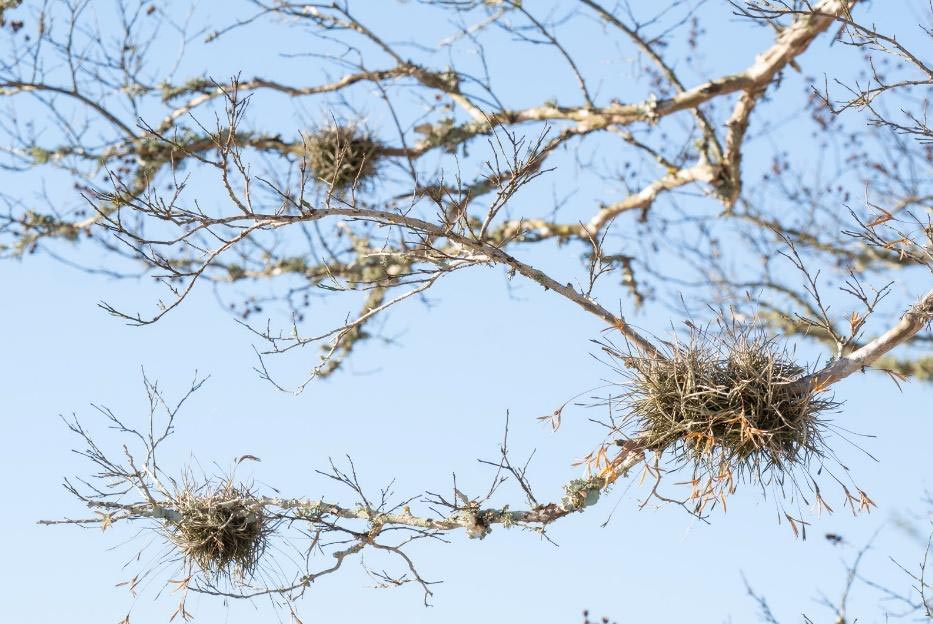
It thrives in humid, shaded, and low-airflow environments — conditions often found within mature tree canopies in Texas. It tends to colonize the interior branches of large live oaks, cedar elms, and other hardwoods where sunlight penetration is low.
Importantly, it's not parasitic and doesn't draw water or nutrients from the tree itself. It simply uses branches as a perch.

The presence of ball moss is often a sign of tree stress, not the cause of it. It becomes more visible when canopies thin due to drought, soil compaction, or age. Inner branches receive more sunlight and airflow, and the tree's natural leaf density is reduced, giving the moss open space to grow.
Ball moss contributes to the canopy ecosystem by:
Ball moss rarely harms healthy trees. In most cases, it's purely cosmetic. Heavy clumps may shade leaves or add minor weight, but the solution is simple — selective pruning of heavily infested limbs during normal maintenance cycles.
We do not recommend manual removal or chemical sprays, as these methods can damage bark and disrupt the tree's natural balance. However, if a client insists upon removal, we can discuss the best plan for extraction or removal.
Healthy trees naturally outcompete ball moss by producing denser foliage and stronger branches. Our arborists recommend:
Ball moss is more a sign of nature's balance than a threat. With healthy soil, proper nutrition, and routine arborist care, your trees will easily coexist with it.
Looking to learn more about tree resources? Check out our tree resources page for tips, guides, and expert advice on keeping your trees healthy and safe.